

24-hour ECG · Riga, Purvciems

Holter Monitoring in Riga — 24-hour ECG

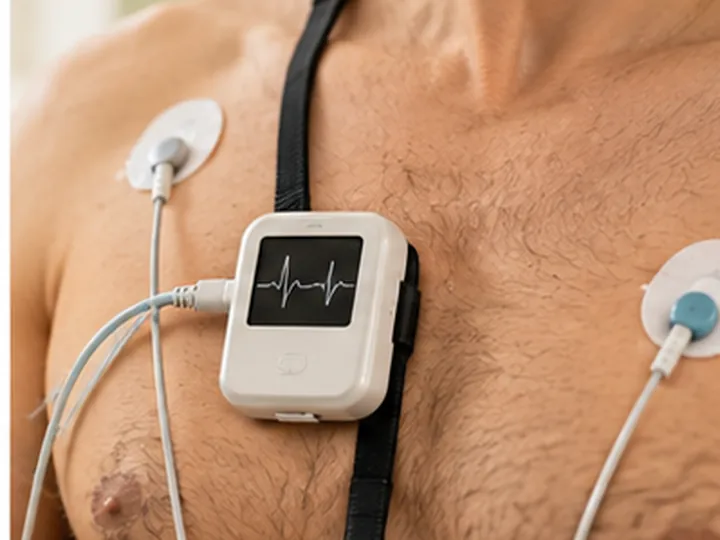
Holter monitoring is an ECG recording over 24 or 48 hours while you go about your usual activities. You wear a small recorder under your clothes, and it records your heart’s activity day and night. The test is painless, and the recording is analysed by a cardiologist.

  • No referral needed
  • 24 or 48 hours of recording
Holter ECG – 24-hour heart monitoring at Grand Medical

What the doctor assesses

What Holter monitoring shows

A standard ECG records the heart for a few minutes. Holter monitoring records for much longer and in everyday life: while walking, resting, feeling stressed and sleeping. That is why it can catch disturbances that only appear from time to time.

  • Occasional rhythm disturbances

    Extrasystoles, tachycardias, pauses. Holter monitoring picks up even brief episodes that a standard ECG does not show.

  • Conduction disturbances

    Heart blocks — when the electrical impulse travels through the heart with delays or interruptions.

  • Myocardial ischaemia

    Signs of insufficient blood supply to the heart muscle, including silent episodes the patient may not have been aware of.

  • Causes of dizziness and fainting

    How the heart behaved during moments of weakness, dizziness, fainting or a feeling of the heart “skipping”.

  • Effect of exertion, stress and sleep

    How the rhythm changes during physical activity, stress, rest and night-time sleep.
  • Treatment effectiveness and pacemaker

    Helps assess how well the prescribed treatment works and whether a pacemaker is functioning correctly.

What Holter monitoring does not show. It records the heart’s electrical activity but does not show the structure of the chambers and valves — to see these, doctors use echocardiography.

The doctor assesses the result together with your symptoms and other tests. A normal recording does not rule out every possible problem: an episode may simply not occur during the monitoring period.

Indications

When a doctor may recommend Holter monitoring

Holter monitoring is usually recommended to find out whether there are rhythm disturbances that occur in episodes, or to check how the heart is working in a known condition. Whether you need the test is for your doctor to decide.

  • Irregular heartbeat or the heart “skipping”A feeling that the heart beats unevenly, stops or “skips”.
  • Suspected arrhythmia with a normal ECGA standard ECG is short and may miss an episode that does not happen every minute.
  • Weakness, fainting, sudden fatigueEpisodes whose cause the doctor wants to check in relation to heart function.
  • Coronary heart diseaseFollow-up of an established diagnosis, including a search for silent episodes of ischaemia.
  • Taking antiarrhythmic medicationChecking how well the prescribed treatment is working.
  • Implanted devicesChecking that a pacemaker works correctly in everyday life.
  • Rhythm monitoring during exertionWhen the doctor needs to see how the heart responds to normal activity.
  • How often to repeatThere is no single schedule “for everyone”: whether a repeat test is needed, and when, is for the doctor to decide.


Sudden severe chest pain, sudden shortness of breath or loss of consciousness are not a reason for a routine appointment. In such cases, call the emergency medical service straight away on 113 (or 112).

Who performs the examination

Doctors who perform Holter monitoring

The Holter recording is analysed by a cardiologist, and a nurse fits the recorder. If you are not sure which doctor to see, our reception will help you choose a doctor and a convenient time.

Elena Shafro, cardiologist at Grand Medical

Elena Shafro

Certified cardiologist

Provides consultations and performs echocardiography. Works with patients with chronic heart conditions, heart failure and rhythm disorders.

More about the doctor →

Irina Mitkevich, cardiologist at Grand Medical

Irina Mitkevich

Certified cardiologist

Member of the Latvian Society of Cardiology and the Latvian Society of Atherosclerosis and Hypertension. Sees patients as a cardiologist at the clinic.

More about the doctor →

Polina Andersone, cardiologist at Grand Medical

Polina Andersone

Certified cardiologist

Diagnosis and treatment of hypertension, rhythm disorders and heart failure. Sees adults and teenagers from the age of 12.

More about the doctor →

Step by step

How Holter monitoring works

Holter monitoring involves two visits to the clinic: fitting the recorder and removing it. In between, you live your normal life while the recorder records your heart.

  1. Booking

    Online, by phone or on WhatsApp. Choose the duration — 24 or 48 hours. Confirm the time of the visit to remove the recorder when you book.

  2. Fitting

    At the clinic, a nurse attaches the electrodes to your body and connects a small recorder. Fitting takes 10–15 minutes.

  3. Wearing and diary

    For 24 or 48 hours you go about your usual activities and keep a symptom diary. You must not bathe or shower during monitoring.

  4. Removal and report

    After the recording period you come back to the clinic and the recorder is removed. A cardiologist analyses the data, and the report is ready within one week after the recorder is removed.

What the patient feels. The test is painless and needs no recovery period. The recorder is worn under your clothes, so you can walk, rest and sleep as usual — this way the heart is recorded in real-life conditions.

Checklist

Preparing for Holter monitoring

No complicated preparation is needed. A few simple steps will help you get a good-quality recording and an accurate analysis.

Before fitting

  • Shower beforehand: you must not bathe or shower during monitoring.
  • Wear comfortable clothing that gives easy access to your chest.
  • Men with heavy chest hair should safely shave the electrode areas beforehand: this helps the electrodes stick firmly to the skin and gives a correct recording.
  • If possible, remove metal jewellery.
Diagram of Holter electrode placement on the chest
Electrode placement areas

While wearing the recorder

  • Keep a symptom diary: write down the time, what you felt (irregular heartbeat, dizziness, weakness) and what you were doing at that moment.
  • Live your normal life: Holter monitoring assesses the heart in everyday conditions.
  • Do not get the electrodes or the recorder wet: no bathing or showering.
  • Bring your diary when the recorder is removed — the doctor will compare it with the recording.

After the examination

Results and next steps

  • Report within one week

    A cardiologist analyses the recorded data and prepares the report. It is usually ready within one week after the recorder is removed.

  • Holter monitoring is part of the Check-up programme

    Holter monitoring can be done on its own or as part of a comprehensive health check-up. More about the Check-up programmes.

  • The result is assessed as a whole

    The recording is considered together with your symptoms, your symptom diary, the examination and other tests. A normal result does not rule out every possible heart problem — sometimes additional tests are needed.

  • What next

    To discuss your results and next steps, book a cardiologist consultation.

Diagnostic methods

Holter, ECG and echo: what is the difference

These tests answer different questions and often complement each other. You do not need to have all three “just in case”: the doctor chooses the method for the specific question.

  • This page

    Holter monitoring

    What it examines
    A continuous ECG recording (24–48 hours) while you go about your usual activities.
    Helps answer
    Whether there are rhythm disturbances that do not appear on a short ECG recording.
  • ECG

    Electrocardiography

    What it examines
    The heart’s electrical activity and rhythm during a short recording.
    Helps answer
    How the heart contracts in terms of rhythm and conduction at the time of the test.
  • Echo

    Echocardiography (heart ultrasound)

    What it examines
    An image of the heart: chambers, walls, valves and blood flow.
    Helps answer
    How the heart is built and how well it pumps blood.

Price

Price and insurance

Holter monitoring

60 € 24 hours

95 € 48 hours

Fitting the recorder, the recording, analysis by a cardiologist and the report. Booking without a referral.

Additional services — for example, a cardiologist consultation or other examinations — are agreed and paid for separately.

Health insurance

  • Страховая компания Balta / Apdrošināšanas sabiedrība Balta — партнёр Grand Medical
  • Страховая компания Seesam / Apdrošināšanas sabiedrība Seesam — партнёр Grand Medical
  • Страховая компания BTA / Apdrošināšanas sabiedrība BTA — партнёр Grand Medical

The clinic works with the insurance companies Balta, Seesam and BTA. Coverage depends on the terms of your policy — check with your insurer before your visit or ask reception when booking.

Grand Medical is entered in the register of medical institutions under number 001000286.

FAQ

Frequently asked questions

A standard ECG records the heart for a few minutes during the appointment. Holter monitoring records the ECG for 24 or 48 hours while you go about your usual activities, so it can capture rhythm disturbances that occur in episodes.

No, you can book Holter monitoring without a referral. If you have one, please bring it with you.

The recording lasts 24 or 48 hours. Fitting the electrodes and the recorder takes 10–15 minutes. If you are not sure which duration to choose, ask when you book.

A nurse fits the electrodes and the recorder. The recording is then analysed by a cardiologist.

Yes. When the recording period ends, you need to come to the clinic to have the recorder removed. Confirm the time of the visit when you book.

A cardiologist analyses the recording, and the report is ready within one week after the recorder is removed.

No, you must not bathe or shower during monitoring. Take a shower beforehand, before the recorder is fitted.

Men with heavy chest hair are advised to shave the electrode areas beforehand. This helps the electrodes stick firmly to the skin and gives a correct recording.

Yes, we recommend keeping a diary. Write down the time and what you felt (irregular heartbeat, dizziness, weakness), and what you were doing at that moment. Bring the diary when the recorder is removed — the doctor will compare it with the recording.

No. The test is painless and needs no recovery period.

The clinic works with Balta, Seesam and BTA. Coverage depends on your policy — check with your insurer or ask reception when booking.

Booking

Book Holter monitoring

Choose a convenient way: a booking portal, phone, WhatsApp or a request on the website — reception will contact you and help find a time for fitting and removing the recorder.

Book online

Can't find a suitable time, or are all slots taken? Contact us — we'll help you book an appointment.

Booking request

Leave your contact details — reception will contact you during working hours and confirm the visit. A request is not yet a booking for a specific time.

By submitting the request, you agree to the personal data processing policy.

Galvas un kakla asinsvadu doplerogrāfija (DUPLEX)

1 novembrī

Ļauj atklāt aterosklerozi, trombus, aneirismas un citas patoloģijas. Tiek izmantota slimību diagnosticēšanai, kā arī profilaktiskajiem izmeklējumiem, īpaši cilvēkiem ar riska faktoriem.