

Heart diagnostics · Riga, Purvciems
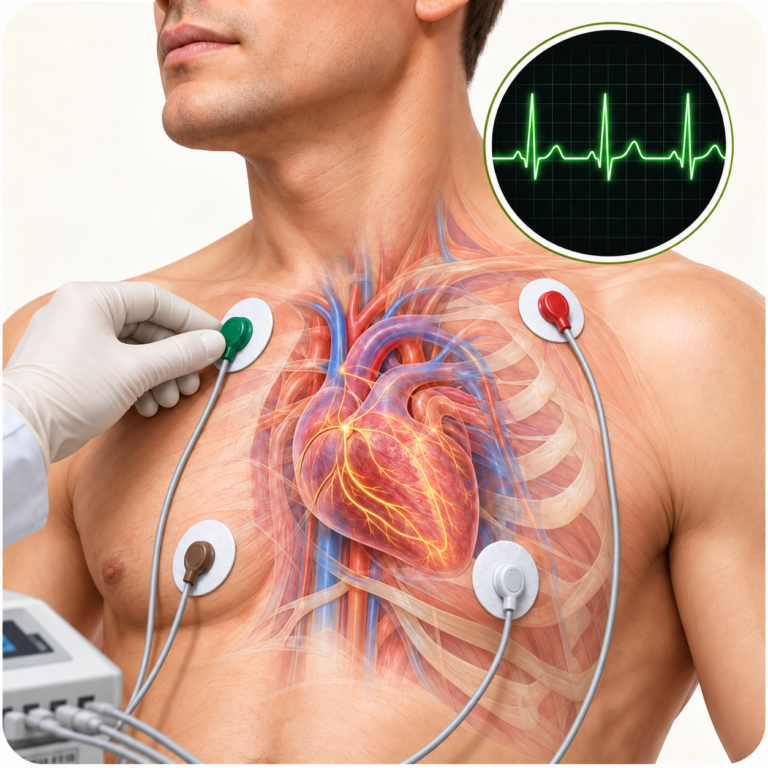
Electrocardiography (ECG) is a quick, painless test that records the electrical activity of the heart. It helps the doctor assess heart rhythm, heart rate and conduction.
What the doctor assesses
An ECG records the electrical signals that make the heart contract. From this recording the doctor assesses several aspects of how the heart works.

The doctor sees how regularly and how fast the heart beats, and whether there are marked irregularities.

How the electrical impulse travels through the heart. The recording can reveal conduction blocks.

Some changes on the recording may point to an inadequate blood supply to the heart muscle.

Indirect signs of thickened heart walls (hypertrophy) or enlarged heart chambers.

How the node that sets the heart's rhythm is working, and whether its function is disturbed.

Changes that may remain after a previous heart attack (myocardial infarction).

Good to know. An ECG records the heart's activity over a short period. Rhythm disturbances that occur only occasionally may not appear on it — in such cases the doctor may suggest Holter monitoring. An ECG does not show the structure of the heart or the condition of its valves: that is what echocardiography is for. The doctor decides which test you need.
Indications
An ECG is one of the most common basic heart tests. Whether you need one in your situation is decided by the doctor, based on indications.
Who performs the examination
ECGs at Grand Medical are performed by the clinic’s cardiologists. If you are not sure which doctor to see, our reception will help you choose a doctor and a convenient time.
Step by step
A standard resting ECG takes 5–10 minutes, including attaching the electrodes. Here is what the visit looks like, from booking to the report.
Online, by phone or on WhatsApp. No referral is needed. Reception will answer organisational questions.
You uncover your chest, wrists and lower legs and lie down on the couch.
The doctor carefully attaches 12 electrodes to the chest, wrists and lower legs. You lie still while the machine records the electrical impulses of the heart.
The cardiologist's report is included in the price of the examination. It will be ready within a couple of days.
What the patient feels. The examination is painless: no injections and no anaesthesia. You may feel light pressure from the electrodes and the coolness of the gel. During the recording it is important to lie still and breathe evenly. You can return to your usual activities straight after.
Quick guide
No special preparation is needed. A few simple steps will help the examination go smoothly.
After the examination
After the examination the cardiologist prepares a report. It will be ready within a couple of days.
An ECG can be done on its own or as part of a comprehensive check-up. More about the Check-up programmes.
ECG findings are considered together with your symptoms, the examination and other tests. A normal ECG does not rule out every possible heart problem — sometimes additional tests are needed.
The ECG report describes the results of the examination. If you need a review of your overall situation and treatment recommendations, book a cardiologist consultation — this is a separate service.
Diagnostic methods
These tests answer different questions and often complement each other. You do not need to have all three “just in case”: the doctor chooses the method for the specific question.
Price
30 €
The examination and the cardiologist's report. Booking without a referral.
Additional services — for example, a cardiologist consultation or other examinations — are agreed and paid for separately.


The clinic works with the insurance companies Balta, Seesam and BTA. Coverage depends on the terms of your policy — check with your insurer before your visit or ask reception when booking.
Grand Medical is entered in the register of medical institutions under number 001000286.
FAQ
An ECG records the heart’s electrical activity: rhythm and conduction. A heart ultrasound (echocardiography) shows its structure, valves and blood flow. These are different methods, and the doctor chooses between them for your situation.
No, you can book an ECG without a referral. If you have one, bring it with you.
Usually 5–10 minutes, including attaching the electrodes.
No. The examination is painless: you lie on the couch and the electrodes only record the heart’s signals.
No. Wear comfortable clothing that gives access to your chest, wrists and lower legs and, if possible, avoid strenuous activity immediately before the examination. Ask about individual questions when you book.
Within a couple of days.
Yes. The €30 price includes the examination and the cardiologist’s report.
The clinic works with Balta, Seesam and BTA. Coverage depends on your policy — check with your insurer or ask reception when booking.
No. A cardiologist consultation with a review of your situation and treatment recommendations is a separate service. If you would like to combine it with an ECG, tell us when you book.
There is no single schedule: the doctor determines the frequency based on indications and your situation.
Booking
Choose a convenient way: a booking portal, phone, WhatsApp or a request on the website — reception will contact you and help find a time.
Book online
Can't find a suitable time, or are all slots taken? Contact us — we'll help you book an appointment.
Leave your contact details — reception will contact you during working hours and confirm the visit. A request is not yet a booking for a specific time.
By submitting the request, you agree to the personal data processing policy.
Ļauj atklāt aterosklerozi, trombus, aneirismas un citas patoloģijas. Tiek izmantota slimību diagnosticēšanai, kā arī profilaktiskajiem izmeklējumiem, īpaši cilvēkiem ar riska faktoriem.